Things We Love: Waste to Form
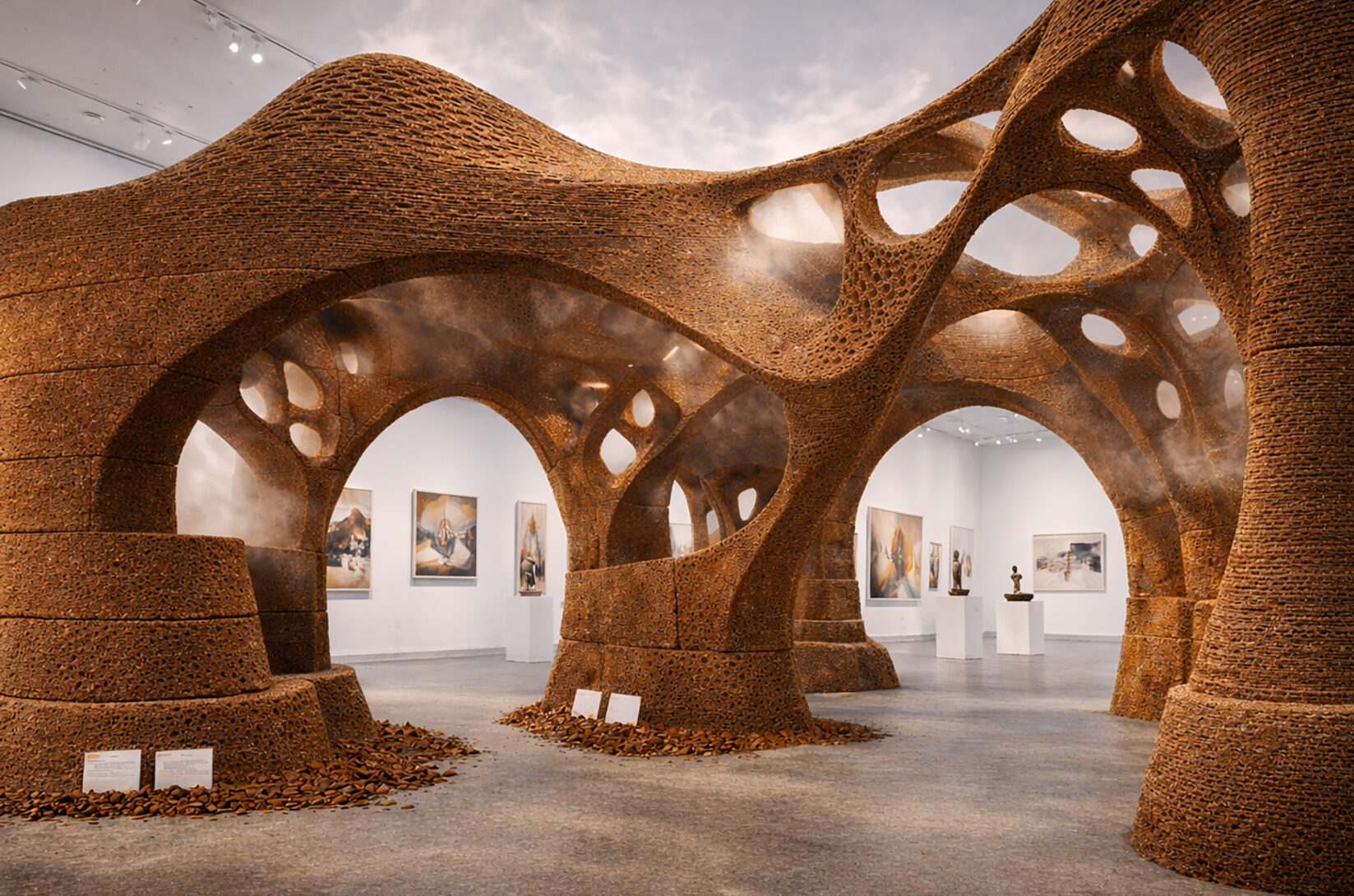
We’re inspired by projects that treat waste as a resource – using design to turn overlooked materials into something considered and useful.
Melbourne produces an extraordinary amount of spent coffee grounds every day and most of it goes straight to landfill. Waste to Form, a research-led installation showing at RMIT’s Design Hub across the final weekend of Melbourne Design Week, asks what happens if you treat that waste stream as a building material instead – a question closely aligned with industrialised construction and sustainable building innovation.
The answer, it turns out, is architecture you can smell.
A team from RMIT’s Schools of Architecture, Science and Engineering has transformed spent coffee grounds into a biodegradable 3D-printing filament, used to produce a series of modular components that assemble into a spatial installation. Each module varies in surface texture, porosity and geometry – not without intent, but through a parametric design system that carefully calibrates how each piece looks, feels, sounds and even smells. Here, scent is not incidental to the material, but deliberately designed, sitting alongside principles of prefabrication, advanced manufacturing and computational design.
This is what resonates with us. The balance between repeatability and variation is something we consider often. Rather than a trade-off between efficiency and character, Waste to Form highlights a more nuanced position – where variation is intentionally designed, sensory qualities are embedded, and circular materials can sit comfortably within scalable, design-led systems.
The project is also a reminder of how much design intelligence is being applied to the question of what construction uses and what it leaves behind. The Australian construction industry generates an enormous volume of waste. Factory-based modular construction already addresses part of that problem – offsite construction in a controlled environment enables more precise material use, reduces landfill, and supports circular economy outcomes through reuse and recycling.